Redeeming Trauma Part II: Healing, Integration, and EMDR as a God-Honoring Pathway
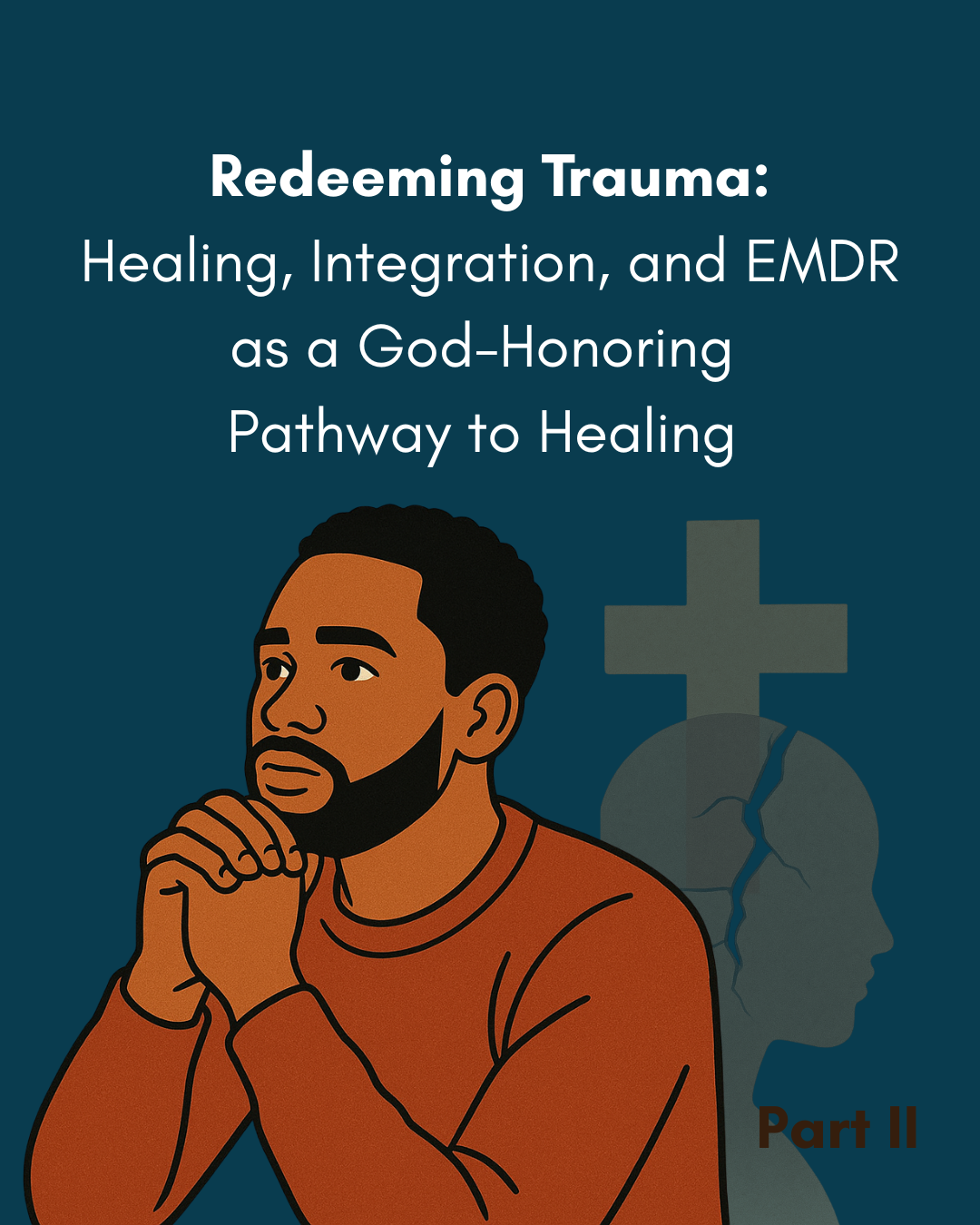
Trauma disrupts shalom. It tears at our ability to trust God, others, and ourselves.
In the previous article, we explored Judith Herman’s definition of trauma as an experience that disrupts connection, meaning, and a sense of safety, often leaving a person feeling helpless or struggling to cope. We introduced Dan Siegel’s Window of Tolerance as the range in which a person can function and respond appropriately while encountering a stressful experience. Within the window, an individual can remain relationally engaged; once dysregulated, a person will enter a fight, flight, or freeze response for survival. This article will explore how trauma gets stored through memory networks, how EMDR works, and how EMDR can be integrated into a biblical Worldview.
Adaptive vs. Maladaptive Networks
In neurobiological terms, trauma embeds itself in what Eye-Movement Desensitization and Reprocessing (EMDR) calls maladaptive memory networks—clusters of memories, emotions, and sensations that stay “stuck” because the brain was unable to process when the event occurred. These networks operate like closed loops, triggering distress whenever something similar arises. For example, if the first time you saw a dog was when one approached you aggressively, that can shape your default responses to all dogs that you encounter in the future.
In trauma, an event overwhelms this system. The memory is stored without proper context or resolution, as if frozen in time through one of 8 components: sight, sound, smell, taste, hearing, touch, feelings, body sensations, or thoughts.[3] As a result, a present event can activate that old network through one of these components, causing someone to feel as though the past is happening now.
Think of it like being on a strong wifi network, then a particular incident occurs. The event causes you to switch to a wifi network with a poor signal that keeps dropping, even if you were not aware. This disconnection is representative of a trauma response. Our hope is to gain the skills to return and connect to an adaptive network so we can function optimally.
Often, my clients realize that a behavior was once adaptive or helpful. That behavior becomes maladaptive or unhelpful over time. For instance, imagine if you called yourself lazy during your teen years to motivate yourself to complete your homework. At the time, it worked! You might have been able to improve your grades. However, in your late 20s, you begin to overwork. You miss out on time with your family, and your relationship begins to suffer because you have to prove to others that you are not lazy. What was adaptive has become maladaptive and no longer serves you as it did initially.
God designed the human brain to heal. Psalm 139:14 declares, “I am fearfully and wonderfully made.” Our neural architecture reflects divine wisdom. The Adaptive Information Processing (AIP) model, which underlies EMDR, rests on the premise that the brain is wired to process and integrate experiences toward wholeness.[4] Big “T” and Little “t” trauma disrupt the natural flow of memory and meaning-making, yet these pathways can be restored.
Paul’s words in 2 Corinthians 10:5—“We take captive every thought to make it obedient to Christ”—align beautifully with this process. EMDR helps individuals bring those captive, looping thoughts and images into awareness so they can be reprocessed in safety, truth, and God’s presence.
How EMDR Works
Eye Movement Desensitization and Reprocessing (EMDR) is a structured, eight-phase therapy that helps individuals process distressing memories by engaging both hemispheres of the brain through bilateral stimulation (BLS) (such as eye movements or tapping). While the person recalls the traumatic memory, the brain is guided to reprocess it, moving it from the emotional centers (amygdala) into adaptive memory networks where it can be integrated and neutralized.
Merely talking about what happened in the past places both feet in the past, is retraumatizing, and can make it feel like the trauma is happening right now. The BLS that EMDR utilizes keeps a person from being retraumatized because it is as if you are placing one foot in the present and one foot in the past. This “Dual Awareness” allows an individual to see the incident in a different light and removes the sting of the original occurrence.[5]
Often, the reason that events or memories are distressing is that we do not have the resources to deal with the trauma when it occurs. For instance, if I am 4 years old and being picked on by an 8-year-old, that can cause major distress. At 4, I might not know what to do. I might not even have the words to describe what I am experiencing. However, if I am 40 and an 8-year-old tries to bully me, that is laughable. At this age, I have learned how to deal with stress and have built resources such as courage, bravery, or even simple logic that give me assurance that an 8-year-old bully is not a threat to me.
The EMDR Process
EMDR has eight phases, which I will quickly summarize.
The initial phase consists of history taking and treatment planning. It provides a map to identify where we are going and how you want to feel when you get there.
Phase 2 is preparation, which comprises building skills and resources aiding in reprocessing. This phase gives you tools to keep you grounded within the window of tolerance. I typically do phases 1 & 2 in a single session.
Phases 3 - 7 are the reprocessing phases and can be completed in a single session. Phase 3 is an assessment that measures the level of distress and provides the target we aim to relieve the sense of disturbance.
Phase 4 is desensitization. Individuals allow their brains to reprocess the distressing incident and decrease the level of disturbance they initially experienced. In essence, how the stomach digests food, EMDR helps the brain “digest” memories that were previously undigested and misstored, which caused the disturbance.
Phase 5 is installing a positive belief or sense of accomplishment. It is one thing to know the truth, but another to feel and believe it.
Phase 6 is the body scan to ensure that there is no negative body sensation. The body holds and records memory [6], thus, it needs to be scanned to ensure that the body is not holding on to any trauma.
Phase 7 is closure if we have “cleared” the memory or if we need to pause at the conclusion of the session for that appointment. It allows you to be checked on and offered containment if necessary.
There is an 8th phase known as reevaluation. This phase occurs when a memory has not been fully reprocessed and needs to return to Phase 4 for further desensitization. Phase 8 also includes a future template that can build resources for the future.
A vast majority of my clients see transformative improvement in 5-7 sessions.
The event remains part of one’s story, but it no longer defines or controls it. Many client experiences are similar to when Joseph said to his brothers, “You meant it for evil, but God meant it for good” (Genesis 50:20). They see the event as something that happened, yet the emotional charge diminishes, and the truth of God’s redemption can be felt, not just known.
Integration: God’s Intention for Wholeness
Many trauma survivors describe feeling “split” into parts. Some parts carry pain, others manage, and others hide. This echoes Paul’s teaching in 1 Corinthians 12 about the body: “If one part suffers, every part suffers with it.” The same principle applies internally. Healing requires each “part” of us to be acknowledged, cared for, and reintegrated under Christ’s Lordship.
This is God’s intention: that the fragmented soul becomes whole again. Colossians 1:17 declares, “In Him all things hold together.” EMDR and “parts work” (Internal Family Systems or similar approaches) can be faithful means of cooperating with this divine design. These methods are considered secular or have humanistic origins. However, as a Christian, I live in a world that Christ redeemed, and I consistently integrate the Lord and the Holy Spirit into the work I do. Jesus’ life on earth demonstrated bringing disowned, fearful, or traumatized people into wholeness. This integration brings aspects of the self back into harmony with the truth of who we are in Christ.
Why EMDR Can Honor God
When done within a faith-sensitive, clinically excellent, and biblically accurate context, EMDR mirrors the biblical process of renewal: “Be transformed by the renewing of your mind” (Romans 12:2).
This “renewing” (anakainosis in Greek) means renovation—clearing away what is old and broken to make room for the new. EMDR provides a clinical mechanism for that spiritual truth to take shape in the brain and body.
Healing trauma is, at its core, a work of grace. God invites the traumatized soul to re-enter relationship, to reestablish trust, and to rediscover His image within. Isaiah 61:1 foretells this mission: “He has sent me to bind up the brokenhearted, to proclaim freedom for the captives.”
EMDR, grounded in both neuroscience and compassion, can serve as one of God’s instruments for that binding up—helping people experience the freedom Christ promised: “If the Son sets you free, you will be free indeed” (John 8:36).
If you would like to explore the trauma you have experienced, please reach out to schedule a free consultation so you can begin on the path of restoring shalom.
References
[1] Herman, J. L. Trauma and Recovery: The Aftermath of Violence--from Domestic Abuse to Political Terror. Basic Books: New York. 2022.
[2] Siegel, D. The Developing Mind: How Relationships and the Brain Interact to Shape Who We Are. Guilford Press: New York. 1999.
[3] Jarero, I., & Artigas, L. (2020). AIP model-based acute trauma and ongoing traumatic stress theoretical conceptualization (third edition). Iberoamerican Journal of Psychotraumatology and Dissociation, 10(1), 1-10.
[4] Shapiro, F. (2001). Eye movement desensitization and reprocessing: Basic principles, protocols, and procedures (2nd ed.). Guilford Press.
[5] Shapiro, F. (2001). Eye movement desensitization and reprocessing: Basic principles, protocols, and procedures (2nd ed.). Guilford Press.
[6] Van der Kolk, Bessel. The Body Keeps the Score: Brain, Mind, and Body in the Healing of Trauma.

December 12, 2025
Written by Dr. James E. Francis Jr.
*Image and some text generated with the assistance of AI technology.
Dr. Francis is the founder of Intentional Bridges, a mental health counseling and coaching practice that provides accountability through encouragement and empowerment that drives resilience and spiritual maturity. James helps with issues including anxiety, anger, depression, grief, infidelity, life transitions, stress, marital readiness, men’s issues, relationship issues, race-related issues, pornography addiction, PTSD, and trauma. He believes that therapy should be clinically excellent and theologically accurate. He prioritizes the integration of Scripture with elements of psychology to operate a holistic growth plan. James helps individuals identify and overcome their negative core beliefs. Then walks beside them to promote step-by-step healing from the pain of the past.
.